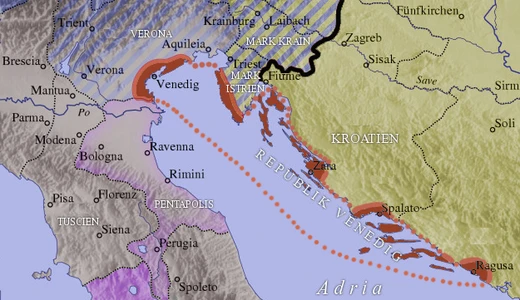
Patria del Friuli
Ecclesiastical state of the Patriarch of Aquileia within the Holy Roman Empire.

The Patria del Friuli, also known as the Patriarchal State of Aquileia, was the territory under the temporal rule of the Patriarch of Aquileia and one of the ecclesiastical states within the Holy Roman Empire. Created in the second half of the 11th century, it existed until the first half of the 15th century, when the Republic of Venice acquired and annexed the territory, formally ending the patriarch's temporal powers in 1445.
- born
- 1077 (creation of the state)
- died
- 1445 (formal renunciation of temporal authority)
- field
- Ecclesiastical state, temporal rule of the Patriarch of Aquileia
- nationality
- Holy Roman Empire
- known_for
- One of the largest polities in Italy; ruled by prince-bishops; eventually annexed by Venice
Lore & Background
The Patria del Friuli was created on 3 April 1077 when King Henry IV of Germany vested Patriarch Sieghard of Beilstein with immediate comital rights in the Friulian lands, raising him to the status of a Prince-Bishop. This act, traditionally regarded as the birth of the ecclesiastical state, led to long-running conflicts with rival margraves from the Carinthian House of Sponheim and the Andechs dukes of Merania. The patriarchs subsequently extended their political control over Friulian lands up to Cadore, the city of Trieste, and central parts of the Istrian peninsula.
In the early 13th century, particularly under Patriarchs Volchero and Berthold, the state had a flourishing economy and cultural life, supported by a good road network. The capital was moved from Aquileia to Cividale and then, from 1238, to Udine. The state faced increasing rivalry with Venice, inner strifes between vassals, and entanglement in the wars between Guelphs and Ghibellines. From about 1400, Venice began gradually occupying the Aquileian hinterlands, and internal conflicts between Cividale and Udine turned into war in 1411. Udine fell to Venice on 7 June 1420 after a long siege, and the core territories were captured. However, the formal renunciation of the patriarch's temporal authority did not occur until 1445, when Patriarch Ludovico Trevisan ceded his temporal rights in exchange for an annual salary from Venice.
Reader's Guide
The Patria del Friuli represents a significant example of an ecclesiastical state within the Holy Roman Empire, where a church leader held both spiritual and temporal power. Its creation in 1077 during the Investiture Controversy highlights the political use of ecclesiastical appointments by the German king. At its height, it was one of the largest polities in Italy, demonstrating the potential reach of prince-bishoprics. The state's eventual absorption by the Republic of Venice illustrates the shifting power dynamics in northern Italy during the late Middle Ages, as rising commercial republics eclipsed older feudal and ecclesiastical structures. The Friulian parliament, which evolved from patriarchal councils, shows early forms of representative governance, though its primary function remained military. The conflict between Cividale and Udine that precipitated the state's fall underscores how internal divisions could be exploited by external powers. The eventual Venetian domination led to the patriarchate becoming a purely Venetian office, marking the end of its independent temporal rule.
Did You Know?
- The Patria del Friuli was created on 3 April 1077 when King Henry IV vested Patriarch Sieghard of Beilstein with comital rights.
- At its maximum height, the Patriarchal State of Aquileia was one of the largest polities in Italy.
- The capital of the state was moved from Aquileia to Cividale and then, from 1238, to Udine.
- Although Udine fell to Venice on 7 June 1420, the patriarch's temporal authority was not formally renounced until 1445, when Patriarch Ludovico Trevisan accepted an annual salary of 5,000 ducats from the Venetian treasur
More in Territories of the Republic of Venice 1-24
Spotted an error? Know more?
This is a living reference — every entry is fact-audited, and reader corrections feed straight into our audit queue. Suggest an edit · See this site's audit record