Belluno
Historic city in the Eastern Dolomites, capital of Belluno province.

Belluno is a town and province in the Veneto region of northern Italy, located about 100 kilometers north of Venice. It is the capital of the province of Belluno and the most important city in the Eastern Dolomites region, with a population of 35,543.
- population
- 35,543
- location
- Veneto, northern Italy
- founded
- circa 220–200 BC
- elevation
- not specified
- area
- not specified
- patron saint
- not specified
- notable residents
- Pope Gregory XVI, Dino Buzzati, Pope John Paul I
Lore & Background
The name Belluno derives from the Celtic belo-dunum, meaning 'shining hill.' The area's population was largely Venetic with a strong Celtic minority. As the Romans expanded northward, the Celts either emigrated or were absorbed. The people swore friendship to Rome in 225 BC during the conflict with the Gauls and again during Hannibal's invasion in the Second Punic War. Founded around 220–200 BC, Belluno initially experienced Roman influence through military and commercial ties, becoming a supplier of iron and copper. It was juridically and politically incorporated into the Roman Republic by the second century BC. Sometime between the death of Julius Caesar and the ascent of Augustus, Bellunum became a Roman municipium, ascribed to the Roman tribe Papiria, and was ruled by quattorviri juri dicendo, quattorviri aedilicia potestate, and a Council of Elders. Under Augustus, it became part of Regio X Venetia et Histria.
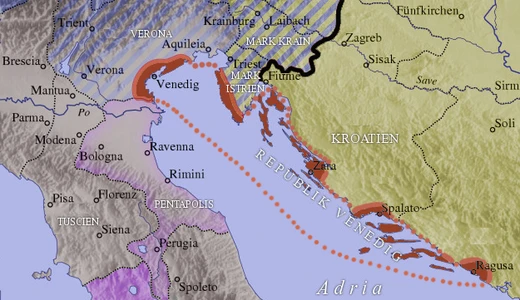
After the fall of the Western Roman Empire, Belluno was ruled by the Lombards in the 6th century and the Carolingians in the 8th century. From the late 9th century, it was ruled by a count-bishop and received a castle and walls. Later it was a possession of the Ghibelline family of the Ezzelino. After contending territory with Treviso, Belluno gave itself to the Republic of Venice during the War of Padua in 1404, becoming an important hub for lumber transport from the Cadore via the Piave river. It remained Venetian until 1797. After the fall of the Venetian Republic, Belluno was briefly under Austrian rule, then from 1805 to 1814 it was part of the Napoleonic Kingdom of Italy, before returning to Austrian control until its annexation to the Kingdom of Italy in 1866. The cathedral was severely damaged by the earthquake of 1873, which destroyed a considerable portion of the town, though the campanile stood firm.
Reader's Guide
Belluno's significance lies in its long history as a strategic Roman municipium, a medieval count-bishop seat, and a key Venetian hub for lumber transport. Its location at the confluence of the Torrente Ardo and Piave River, with the Schiara range of the Dolomites to the north, has made it a gateway to the Eastern Dolomites. The city is one of 15 municipalities of the Dolomiti Bellunesi National Park. Its monuments include the Duomo with an 18th-century bell tower designed by Filippo Juvarra, the Palazzo dei Rettori (1491), and the Bishop's Palace (1190). The city has hosted stages of the Giro d'Italia and will be involved in the Milan Cortina 2026 Winter Olympics and Paralympics. Notable figures from Belluno include Pope Gregory XVI, novelist Dino Buzzati, sculptor Andrea Brustolon, and painter Sebastiano Ricci. The city's demographic profile as of 2025 shows a population of 35,543, with 8.8% foreign residents. Belluno is twinned with Cervia, Italy, and Bend, United States.
Did You Know?
- The name Belluno derives from Celtic belo-dunum, meaning 'shining hill.'
- Belluno became a Roman municipium sometime between the death of Julius Caesar and the ascent of Augustus.
- The cathedral's bell tower was designed by Filippo Juvarra in the 18th century.
- Belluno was part of the Napoleonic Kingdom of Italy from 1805 to 1814, between two periods of Austrian rule.
Ancient Roots & Roman Integration
The very name of Belluno carries the echo of a pre-Roman world. Derived from the Celtic belo-dunum, meaning "shining hill," the town's identity was shaped long before Roman boots ever marched up the valley. The earliest inhabitants were largely Venetic, with a significant Celtic minority, and it was this mixed community that first pledged friendship to Rome in 225 BC during the conflict with the Gauls, and again when Hannibal's army swept through the region during the Second Punic War. Founded roughly between 220 and 200 BC, Belluno initially served Rome as a military outpost guarding the cities to the south and as a supplier of iron and copper. By the second century BC it had been formally incorporated into the Republic. In the turbulent interval between Caesar's assassination and Augustus's rise, the settlement was elevated to the status of a Roman municipium, its citizens enrolled in the tribe Papiria and governed by two pairs of magistrates alongside a Council of Elders. Under Augustus it fell within Regio X, Venetia et Histria. A tangible reminder of those early centuries survives in the third-century sarcophagus of Caius Flavius Hostilius and his wife Domitia, set beside the church of San Stefano.
Medieval Power & the Venetian Century
The collapse of the Western Roman Empire set Belluno on a long, shifting path through medieval hands. The Lombards held the town in the sixth century, followed by the Carolingians in the eighth; a remarkable hoard known as the Belluno Treasure, now displayed in the British Museum, dates from precisely this era. By the late ninth century a count-bishop governed the community, which received a castle and a circuit of defensive walls. The Ghibelline Ezzelino family later claimed the territory, and for generations Belluno locked in a bitter contest with neighbouring Treviso over the surrounding lands. That rivalry ended in 1404, when, during the War of Padua, the town voluntarily submitted to the Republic of Venice. Under Venetian rule Belluno found a new economic purpose: it became a vital staging point for moving timber out of the Cadore valley and down the Piave River. The city remained part of the Venetian state until 1797. After the Republic's fall it passed to Austrian control, and it was not until 1866 that Belluno was finally annexed into the newly unified Kingdom of Italy.
Sacred & Civic Architecture
Walk through Belluno's old centre and you pass a dense layering of sacred and civic buildings spanning nearly a millennium. The sixteenth-century Duomo, whose floor plan is credited to the Venetian architect Tullio Lombardo, is crowned by an eighteenth-century campanile designed by Filippo Juvarra. Nearby stand the 1491 Palazzo dei Rettori, the striking red Communal Palace, and the Bishop's Palace, raised in 1190 by count-bishop Gerardo de' Taccoli. The Baroque church of San Pietro, originally Gothic and dating to 1326, holds five canvases by Andrea Schiavone and three by Sebastiano Ricci. In the church of Santo Stefano, visitors can admire fifteenth-century works by local painters alongside an Adoration of the Magi attributed to Tiziano's workshop. The Romanesque church of San Biagio, the sixteenth-century San Rocco, and Santa Maria dei Battuti round out the ecclesiastical landscape, while the ancient gates Porta Dojona and Porta Rugo still mark the old town walls. Piazza dei Martiri, laid out in Renaissance style, serves as the commercial and social heart of daily life. All of this was tested in 1873, when a devastating earthquake shattered much of the town yet left the cathedral's bell tower standing.
Mountain Setting & Modern Life
Belluno perches on a cliff spur where the Torrente Ardo meets the Piave River, roughly one hundred kilometres north of Venice. To the north, the Schiara range of the Dolomites looms over the town, its skyline punctuated by the dramatic Gusela del Vescovà, the so-called Bishopric's Needle, while the peaks of Serva and Talvena rise directly above the city. To the south the Venetian Prealps form a natural barrier before the flat plain, and the Nevegal in the Castionese area offers a local skiing resort. The climate is a warm-summer humid continental type, with an average annual temperature near 10.8 °C and about 1,128 mm of precipitation. As the capital of its province and the largest settlement in Valbelluna, Belluno anchors the Eastern Dolomites region and is one of fifteen municipalities within the Dolomiti Bellunesi National Park. Connectivity is maintained by state roads linking the town to Feltre, Treviso, Ponte nelle Alpi, and Vittorio Veneto, a railway station on the Calalzo–Padua line, and the Dolomiti Bus network. The city has also hosted the Giro d'Italia finish line five times, from 1938 to 1966.
Frequently Asked Questions
What is Belluno in the Venetian territories?
Belluno is a historic town and the seat of its own province in the Veneto region of northern Italy, sitting roughly 100 kilometers north of the lagoon city. It is the principal urban center of the Eastern Dolomites.
When was Belluno founded?
The settlement traces its origins back to approximately 220–200 BC, making it one of the older communities in the Veneto landscape.
What is Belluno's role within the Republic of Venice?
It serves as the administrative capital of the province of Belluno and anchors the mountainous eastern sector of Venetian-held territory, functioning as the key hub for the surrounding Dolomite valleys.
How large is Belluno's population?
The city has a population of approximately 35,543 residents, making it the most significant town in the Eastern Dolomites region.
Why is Belluno important to fans of the Republic of Venice?
As the provincial capital and the oldest continuously inhabited center in the area, Belluno represents the mountainous frontier of Venetian influence, giving the territory a distinct alpine character compared to the coastal and lagoon holdings.
More in Territories of the Republic of Venice 1-24
Spotted an error? Know more?
This is a living reference — every entry is fact-audited, and reader corrections feed straight into our audit queue. Suggest an edit · See this site's audit record