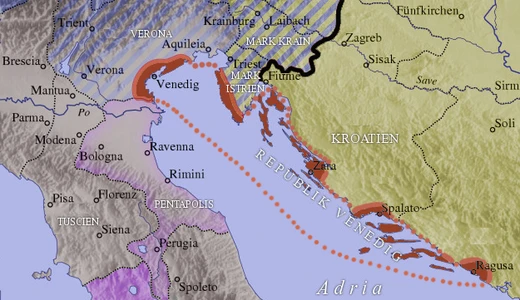
Dalmatia under Venetian rule
Venetian rule over Dalmatia lasted from 1409 to 1797.

For centuries, Venice’s grip on Dalmatia tightened and loosened before it finally locked into place. The Republic first intervened in Dalmatia with a temporary expedition in 998 or 1000, but it did not establish a permanent claim at that time. For most of the period from the 9th to the 14th century, Venetians and Croats fought for control of the eastern Adriatic coast. Venice acquired its first permanent holdings there only in the early 15th century. The turning point came in 1409, when the cash-strapped Ladislaus of Naples sold his claim to Dalmatia to Venice for 100,000 ducats. Although the Hungarian king Sigismund tried to win the territory back, Venice defeated his army at the Battle of Motta in 1412. By 1420, Venice controlled most coastal cities, though some areas like the Republic of Ragusa remained independent, and the hinterland was contested. Dalmatia became a formal part of the *Stato da Màr*—the Republic’s maritime empire.
The region was administered through a network of cities, each run by a local magistrate, all overseen by a high official called the *Provveditore Generale in Dalmazia e Albania* (a title formally used from the 16th century onward), who usually operated out of Zadar. Over the centuries, the Ottoman Empire conquered much of the Dalmatian hinterland. By the late 1700s, the name “Dalmatia” had come to refer only to the coastal strip still held by Venice. That long era ended in 1797, when Napoleon dissolved the Republic of Venice and its Dalmatian territories were handed over to the Habsburg Monarchy.
- start_of_rule
- 1409
- end_of_rule
- 1797
- consolidation
- 1420 (most coastal cities, but Ragusa remained independent and hinterland contested)
- capital
- Zadar
- region
- Dalmatia (eastern Adriatic coast)
- governance
- Provveditore Generale in Dalmazia e Albania (title formally used from the 16th century)
Lore & Background
From the 9th to the 14th century, the Venetians waged wars against the Croats for dominance over the eastern Adriatic coast, acquiring their first permanent possessions only in the early 15th century. In 1409, during a Hungarian civil war, Ladislaus of Naples sold his rights on Dalmatia to Venice for 100,000 ducats. Venice defeated King Sigismund's troops in the Battle of Motta (1412) and took control of most coastal cities by 1420, though the Republic of Ragusa remained independent and the hinterland was contested. The southernmost area was called Venetian Albania.
Reader's Guide
Venetian rule shaped Dalmatia's political and military history for nearly four centuries. The region served as a strategic maritime territory within Venice's overseas empire, the Stato da Màr. Dalmatians served in Venetian military as professional soldiers and conscripts, fighting on fronts from Cyprus to Terraferma. At the Battle of Lepanto, over 9,000 Dalmatians served on the Venetian fleet. In the late 18th century, the geographical term Dalmatia referred solely to the territory under Venetian rule. In 1797, Napoleon dissolved the Republic of Venice, and its Dalmatian territories were annexed by the Habsburg Monarchy.
Did You Know?
- Venetian rule over most coastal Dalmatian cities was consolidated by 1420, but the Republic of Ragusa remained independent and the hinterland was contested.
- Ladislaus of Naples sold his rights on Dalmatia to Venice in 1409 for 100,000 ducats.
- Over 9,000 Dalmatians served on the Venetian fleet at the Battle of Lepanto.
- In 1797, Napoleon dissolved the Republic of Venice, and its Dalmatian territories were annexed by the Habsburg Monarchy.
The Orseolo Push and the Birth of Adriatic Ambition
Venetian claims to Dalmatia's coast trace back to the seventh and eighth centuries, when the Republic's merchant galleys clashed with Slavic coastal communities, including Narentine pirates, over the right to sail the eastern Adriatic free of tribute. For centuries the coast remained a narrow, contested strip of islands and cities—Zadar, Split, Trogir, Dubrovnik, and others—while the hinterland stayed in the hands of Croatian dukes and kings who held courts at Klis, Knin, and Biograd na Moru. The decisive Venetian push came under Doge Pietro II Orseolo, who from 991 redirected the Republic's energy toward the Adriatic. A favourable treaty with Byzantine Emperor Basil II, the so-called Golden Bull, freed Venetian traders from the Kommerkion tax levied on all other foreigners. In 1000, a fleet expedition along coastal Istria and Dalmatia permanently broke Narentine piracy and secured Venetian suzerainty. Orseolo proclaimed himself Duke of Dalmatia and is credited with instituting the Marriage of the Sea ceremony. His son Ottone reinforced this dominance in 1017, yet by the 1030s Croatian kings Stjepan I and Petar Krešimir IV had reclaimed nearly the entire littoral, the latter styling himself King of Croatia and Dalmatia.
A Century of Contest – Normans, Hungarians, and the Fourth Crusade
The eleventh and twelfth centuries saw a relentless tug-of-war over Dalmatia's ports. After Petar Krešimir IV died during the 1074 Norman invasion, the Venetians expelled the Normans in early 1075, and Doge Domenico Selvo styled himself ruler of Venice, Dalmatia and Croatia, though he wielded little real power. That year Demetrius Zvonimir was crowned king of Croatia and Dalmatia by the Holy See, his authority reaching even the islands of Krk and Cres. His death in 1089 triggered a succession crisis; although the 1098 Conventio Amicitiae between Doge Vitale I Michiel and Hungarian King Coloman allotted Dalmatia to Venice and coastal Croatia to Hungary, Coloman conquered the coastal cities by 1105. Throughout the twelfth century, Hungarian kings Coloman and Béla II, with Croatia in personal union with their realm, repeatedly recovered Dalmatian territory, and conflicts rarely ceased. The Fourth Crusade then reshaped the map: in 1202 Venetian and crusader forces captured Zadar, and in 1203 Pope Innocent III excommunicated the entire crusading army. The campaign ultimately led to the siege of Constantinople. In 1356–1358, Hungarian King Louis the Great forced Venice to withdraw, and the 1358 Zadar Peace Treaty stripped the Republic of influence from eastern Istria to southern Dalmatia.
The 1409 Sale and the Architecture of Venetian Rule
The modern period of Venetian Dalmatia began in 1409, when Ladislaus of Naples, the losing contender in a twenty-year Hungarian civil war against King Sigismund, sold his rights to Dalmatia to the Venetian Republic for a meager 100,000 ducats. Sigismund attempted to recover the territory but was defeated at the Battle of Motta in 1412. The Croatian Littoral and eastern Istria, however, remained with Croatia, where Croats and their allies rejected Venetian overtures. By 1420 the more centralized merchant republic had secured control of the coastal cities, with the notable exception of the independent Republic of Ragusa, and Dalmatia was formally incorporated into the Stato da Màr, the Republic's maritime state. The southernmost stretch of the coast, in what is now coastal Montenegro, was administered as Venetian Albania. Governance was structured around magistrate-led cities, all overseen by a Provveditore Generale in Dalmazia e Albania, typically based in Zadar. These coastal towns would remain under Venetian sovereignty for 377 years, from 1420 to 1797, making Dalmatia one of the longest-lasting holdings of the Republic's overseas empire.
Ottoman Shadow and the End of an Era
The Ottoman-Venetian wars of the early sixteenth century, spanning 1499–1503 and 1537–1540, reshaped Dalmatia's strategic landscape. The Ottomans did not occupy the Venetian coastal cities, but they seized the Croatian possessions between Skradin and Obrovac, establishing the Sanjak of Klis and eliminating the buffer zone that had separated Ottoman and Venetian territory. The Venetians still perceived this inner hinterland as historically part of Croatia, referring to it as Banadego, the lands of the Ban. Over the following centuries, the Ottoman advance in the hinterland progressively narrowed the meaning of the word Dalmatia itself; by the late eighteenth century the geographical term had come to refer solely to the narrow strip of territory still under Venetian control. The Republic's long stewardship ended abruptly in 1797, when Napoleon dissolved the Republic of Venice. Its Dalmatian territories were then annexed by the Habsburg Monarchy, closing a chapter of Venetian maritime governance that, in its consolidated form, had endured for nearly four centuries.
Frequently Asked Questions
When did Venice's permanent rule over Dalmatia actually begin?
Although Venetian forces made a brief foray into the region around 998 or 1000, the Republic held no lasting territory there until 1409. That year marks the true start of continuous Venetian governance over the eastern Adriatic coast.
How did Venice obtain Dalmatia?
In 1409, the financially troubled King Ladislaus of Naples transferred his claim to Dalmatia to the Republic in exchange for 100,000 ducats. This transaction gave Venice its first permanent foothold on the eastern Adriatic seaboard.
What was the capital of Venetian Dalmatia?
Zadar served as the administrative capital of the Venetian province of Dalmatia. From there, Republic officials coordinated governance across the coastal cities under Venetian control.
Who governed Dalmatia on behalf of Venice?
The Republic appointed a senior official known as the Provveditore Generale in Dalmazia e Albania to oversee the province. That formal title came into regular use from the sixteenth century onward.
When did Venetian rule over Dalmatia end?
Venetian sovereignty over Dalmatia lasted until 1797, when the fall of the Republic brought an end to its territorial holdings. That date closes nearly four centuries of Venetian administration in the region.
More in Territories of the Republic of Venice 1-24
Spotted an error? Know more?
This is a living reference — every entry is fact-audited, and reader corrections feed straight into our audit queue. Suggest an edit · See this site's audit record