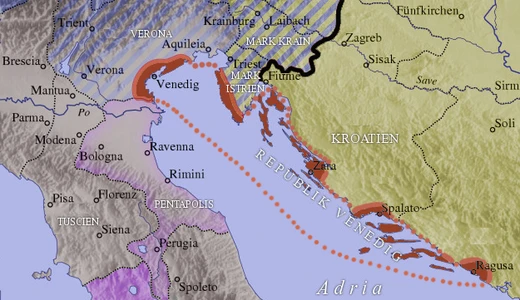
Dogado
Metropolitan territory of the Republic of Venice, headed by the Doge.

The Dogado, also called the Duchy of Venice, served as the home territory of the Republic of Venice, ruled by the Doge. Its traditional founding date is 697, and it lasted until 1797. The territory originally consisted of Venice itself and a narrow coastal strip running from Loreo to Grado. Over time, its borders expanded to reach Goro in the south, the Polesine and Padovano regions to the west, the Trevisano and Friuli areas to the north, and the mouth of the Isonzo River to the east. Venice, the capital, functioned largely as its own city-state. The rest of the Dogado was split into nine districts, listed from north to south: Grado, Caorle, Torcello, Murano, Malamocco, Chioggia, Loreo, Cavarzere, and Gambarare (located in Mira). Earlier, these districts were governed by tribunes elected by the people and gastalds who answered to the Doge. During the Republic’s later period, each district was led by a patrician holding the title of podestà, except for Grado, which was overseen by a Count. The Dogado was one of three main divisions of the Republic’s holdings. The other two were the Stato da Màr (the overseas colonies) and the Stato da Terra (the mainland Italian domains, which formed the strategic and economic hinterland of the Dogado). The term Dogado is the Venetian equivalent of Ducato (duchy), a title used by Italian city-states that, unlike Venice, had a hereditary duke as head of state.
- Type
- Metropolitan territory of the Republic of Venice
- Head
- Doge (traditionally from 697 to 1797)
- Subdivisions
- Nine districts (Grado, Caorle, Torcello, Murano, Malamocco, Chioggia, Loreo, Cavarzere, Gambarare)
- Governance
- Each district led by a patrician podestà, except Grado headed by a Count
- Part of
- One of three subdivisions of the Republic's possessions (alongside Stato da Màr and Stato da Terra)
Lore & Background
The Dogado, also called the Duchy of Venice, was the core territory of the Republic of Venice, ruled by the Doge from 697 until 1797. It originally consisted of Venice and a narrow coastal strip from Loreo to Grado, but its borders later expanded to include areas from Goro southward, the Polesine and Padovano westward, the Trevisano and Friuli northward, and the mouth of the Isonzo eastward. Venice itself served as the capital and functioned as a city-state within the Dogado.
Reader's Guide
The Dogado was one of three subdivisions of the Republic of Venice's possessions, the others being the Stato da Màr (overseas colonies) and the Stato da Terra (mainland Italian domains). Its governance evolved from earlier tribunes elected by the people and gastalds corresponding with the Doge to a system where each of its nine districts was led by a patrician with the title of podestà, except Grado, which was headed by a Count. The term Dogado is equivalent to Ducato (duchy), distinguishing Venice from other Italian city-states that had a duke as hereditary head of state. The Dogado's strategic and economic role as the hinterland of Venice was crucial to the Republic's power, providing a territorial base for its maritime and land empires.
Did You Know?
- The Dogado comprised the city of Venice and a narrow coastal strip from Loreo to Grado, later extending to Goro, the Polesine, the Padovano, the Trevisano, Friuli, and the mouth of the Isonzo.
- The Dogado was subdivided into nine districts: Grado, Caorle, Torcello, Murano, Malamocco, Chioggia, Loreo, Cavarzere, and Gambarare.
- Each district was led by a patrician podestà, except Grado, which was headed by a Count.
- The Dogado was one of three subdivisions of the Republic's possessions, alongside the Stato da Màr and the Stato da Terra.
Territorial Scope & Geographic Evolution
The Dogado began with a surprisingly modest territorial footprint: the city of Venice itself, together with a thin coastal ribbon running between Loreo and Grado. Over the long arc of the Republic's history, however, that narrow strip steadily grew into a far more substantial landholding. The southern boundary was pushed down to Goro, the western reach extended into the Polesine and the Padovano, the northern frontier expanded to take in the Trevisano and Friuli, and the eastern limit advanced all the way to the mouth of the Isonzo. This gradual territorial accretion transformed what had been a compact lagoon settlement into a meaningful mainland presence. As the metropolitan territory of the Republic, the Dogado constituted the foundational base from which Venetian power extended outward to its overseas and mainland possessions, anchoring the state's identity in concrete geography rather than in distant holdings alone.
Districts & Local Governance
Within the Dogado, governance was organized into nine districts arranged from north to south: Grado, Caorle, Torcello, Murano, Malamocco, Chioggia, Loreo, Cavarzere, and Gambarare in Mira. Each district was headed by a patrician bearing the title of podestà, with one notable exception — Grado was led by a Count rather than a podestà. This patrician system replaced an older arrangement in which local governance had been entrusted to tribunes, who were elected directly by the people, and gastalds, whose role was to correspond with the Doge on matters of state. The shift to appointed patricians marked a clear move away from popular election toward a more centralized, aristocratic form of local administration. Venice itself, as capital, functioned in practice as a city-state unto itself, standing apart from the nine districts even as it remained the political heart of the entire Dogado.
The Doge & Political Identity
The Dogado derived its very name from the Doge, the head of the Republic of Venice, who traditionally held the title from 697 until the Republic's fall in 1797. This made the Dogado the equivalent of a ducal territory — a Ducato — in the broader landscape of Italian city-states. The critical distinction, however, was that while other Italian duchies were led by hereditary dukes, Venice's Doge was not a hereditary sovereign. The Dogado thus occupied a unique position: it carried the prestige and nomenclature of a duchy while operating under a fundamentally non-hereditary form of leadership. For nearly eleven centuries, the Doge stood at the apex of this metropolitan territory, embodying both the continuity of Venetian governance and the Republic's deliberate rejection of dynastic rule. The title and the territory were inseparable, each defining the other across the full span of Venetian history.
The Dogado Within the Republic's Empire
The Dogado was never an isolated entity but one of three major subdivisions of the Republic's total possessions. The other two were the Stato da Màr, literally the 'State of the Sea,' encompassing Venice's overseas colonies, and the Stato da Terra, the 'State of the Land,' representing Venice's domains in mainland Italy. Within this tripartite structure, the Dogado occupied a singular and foundational role: it was the home territory, the metropolitan heart from which the Republic's power radiated outward. The Stato da Terra functioned as the strategic and economic hinterland that supported the Dogado, while the Stato da Màr projected Venetian influence across the seas. Together, these three components formed a unified imperial architecture, with the Dogado serving as the political and symbolic center. Its status as the seat of the Doge and the capital city of Venice gave it a primacy that neither the overseas colonies nor the mainland territories could claim.
Frequently Asked Questions
What is the Dogado?
The Dogado, also called the Duchy of Venice, was the metropolitan homeland of the Republic of Venice and the territory directly under the Doge's authority. It is traditionally dated to 697 and endured until the Republic's dissolution in 1797.
What districts made up the Dogado?
Aside from the city of Venice itself, the Dogado was split into nine districts: Grado, Caorle, Torcello, Murano, Malamocco, Chioggia, Loreo, Cavarzere, and Gambarare. Each was run by a patrician podestà, except Grado, which fell under a Count.
How did the Dogado's borders change over time?
It started as a narrow coastal strip running from Loreo to Grado, but gradually stretched south to Goro, west into the Polesine and Padovano, north into the Trevisano and Friuli, and east to the mouth of the Isonzo. This slow accretion turned a modest littoral zone into a substantial mainland territory.
How did the Dogado fit into the Republic's overall territorial structure?
The Republic organized its possessions into three broad categories, and the Dogado served as the metropolitan core alongside the Stato da Màr and the Stato da Terra. Venice itself functioned almost as a self-contained city-state within this tripartite framework.
Who governed the Dogado and how was authority distributed?
The Doge held supreme authority over the entire Dogado, while local administration in each of the nine districts was delegated to a patrician podestà (or a Count in Grado's case). This arrangement let the central government maintain oversight while entrusting day-to-day rule to trusted nobles.
More in Territories of the Republic of Venice 1-24
Spotted an error? Know more?
This is a living reference — every entry is fact-audited, and reader corrections feed straight into our audit queue. Suggest an edit · See this site's audit record