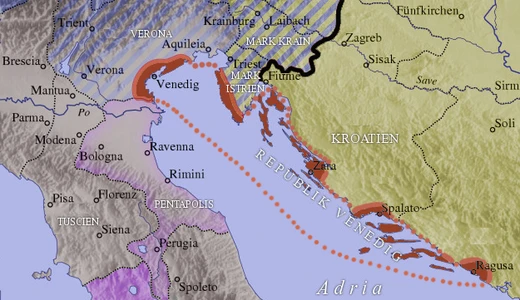
Friuli
Historical region of northeast Italy with a distinct Friulian identity.

Friuli is a historical region in northeastern Italy, known for its distinct cultural and linguistic identity, centered on the Friulian people and their language. It makes up most of the autonomous region Friuli-Venezia Giulia, covering the provinces of Udine, Pordenone, and Gorizia, but not Trieste. The name comes from the ancient Roman settlement Forum Iulii, which today is the town of Cividale del Friuli.
The region’s western border with Veneto follows the Livenza River. To the north, the crest of the Carnic Alps separates it from Austrian Carinthia. The eastern edge runs along the Julian Alps, the Slovenian border, and the Timavo River, while the Adriatic Sea forms the southern boundary. Some adjacent Slovene areas—the Soča/Isonzo valley from Gorizia and Nova Gorica up to Triglav, along with the Vipava Valley, which together make up the Goriška region—are also sometimes considered part of historic Friuli. The mountainous north belongs to the Southern Limestone Alps. From west to east, the highest peaks include Cima dei Preti (2,703 m), Duranno (2,652 m), and Cridola (2,581 m) in the Carnic Prealps; Peralba (2,694 m), Monte Bìvera (2,474 m), and Coglians (2,780 m) in the Carnic Alps; and in the Julian Alps, Jôf Fuârt (2,666 m), Jôf di Montasio (2,754 m), Mangart (2,677 m), and Canin (2,587 m), which overlooks the plain.
Numerous rivers flow south from the mountains. The Tagliamento River winds through the Friulian mountains, crosses the hills near Gemona del Friuli, and then spreads into a broad flood plain. This plain splits into the High Friulian plain and the Low Friulian plain (Bassa Friulana), divided by the Napoleonic road linking Codroipo and Palmanova. South of that road lies the risorgive zone, where underground water resurfaces in spring-fed pools. Further south are the lagoons of Marano and Grado, both nature reserves. Other important rivers include the Torre, Natisone, Stella, Isonzo/Soča, and Ausa. Friuli covers 8,240 square kilometers, split among the provinces of Udine (4,905 km²), Pordenone (2,178 km²), and Gorizia (466 km²). The historical capital and largest city is Udine, once the capital of the medieval Patria del Friuli. Other notable towns include Pordenone, Gorizia/Nova Gorica, Sacile, Codroipo, Cervignano del Friuli, Cividale del Friuli, Gemona del Friuli, Monfalcone, and Tolmezzo.
The climate on the Friulian plain is mostly humi
- area
- 8,240 square kilometres (3,180 sq mi)
- historical_capital
- Udine
- population
- over 1,000,000
- languages
- Friulian, Venetian, Slovene, Austrian German
- major_rivers
- Tagliamento, Torre, Natisone, Stella, Isonzo/Soča, Ausa
- highest_peak
- Coglians at 2,780 metres (9,120 ft)
- climate_plain
- humid subtropical
Lore & Background
In the prehistoric era, Friuli was home to the Castellieri culture and the Raeti. During the 4th century BC, it was settled by the Carni, a tribe of unknown ethnicity who may have spoken a Celtic, Venetic, or Rhaetic language. Beginning from the 2nd century BC, the Romans colonized Friuli, making Aquileia the fourth largest city of Italy during Roman imperial times and capital of Regio X. Julius Caesar quartered his legions in Aquileia during winter. The development of centers such as Forum Iulii and Iulium Carnicum contributed to economic and cultural wealth until barbarian incursions in the early 5th century. A Hun invasion marked the start of Friuli's decline: Aquileia was razed by Attila in 452, and its reconstruction was never completed.
Reader's Guide
Friuli's significance lies in its enduring regional and ethnic identity, preserved through the Friulian language and cultural institutions such as the Fogolârs furlans associations worldwide. The region's geography, from the Carnic and Julian Alps to the Adriatic lagoons, shaped its history as a crossroads of trade and invasion. The Roman legacy of Aquileia, once a major Adriatic port and bishopric, underscores Friuli's historical importance. Emigration from the late 19th century to the 1970s dispersed over a million Friulians globally, creating a diaspora that maintains cultural ties. Today, Friuli's climate supports wine production, and its mountainous areas are among Italy's rainiest. The region's administrative provinces—Udine, Pordenone, and Gorizia—reflect its historical divisions, with Udine serving as the traditional capital.
Did You Know?
- The name Friuli originates from the Roman town Forum Iulii, now Cividale del Friuli.
- Aquileia was the fourth largest city of Italy during Roman imperial times.
- The Julian Prealps, part of Friuli, is one of Italy's rainiest regions, with Musi receiving about 3,300 mm of annual precipitation.
- Over a million Friulians emigrated between the late 19th century and the 1970s.
More in Territories of the Republic of Venice 1-24
Spotted an error? Know more?
This is a living reference — every entry is fact-audited, and reader corrections feed straight into our audit queue. Suggest an edit · See this site's audit record