Este, Veneto
Town at the foot of the Euganean Hills, origin of the House of Este.

Este is a town and comune in the Province of Padua, Veneto, northern Italy, situated at the foot of the Euganean Hills. It is notable as the namesake of the Este culture, a proto-historic culture spanning from the late Italian Bronze Age to the Roman period, and as the origin of the House of Este, a medieval dynasty that took its name from the town.
- Roman_colony_established
- Late 2nd century BC (around 135 BC)
Lore & Background
During the Iron Age, Este was a major center of the Veneti, who left numerous inscriptions on funerary and votive objects. In the late 2nd century BC (around 135 BC), it peacefully fell under Roman sway and became the colony of Ateste. When much of Northern Italy received Roman citizenship in 49 BC, Este's citizens were inscribed into the Romilia tribe. After the Battle of Actium, Emperor Augustus settled soldiers of Legio V Alaudae and Legio XI Claudia in Este's territory, which included several surrounding towns.
In Late Antiquity, barbarian invasions, especially by Attila, devastated Este, reducing it to a rural village. It revived after the 10th century when the Obertenghi family began ruling the area and adopted the name House of Este. Azzo II d'Este built a castle there, naming himself and his family after it. The House of Este held the city until the 13th century, when its main residence gradually shifted to Ferrara (Obizzo II d'Este became lord of Ferrara in 1264). Este was conquered by Ezzelino da Romano III in 1238, and was later disputed by the Scaligeri, Carraresi, and Visconti before surrendering to Venice in 1405.
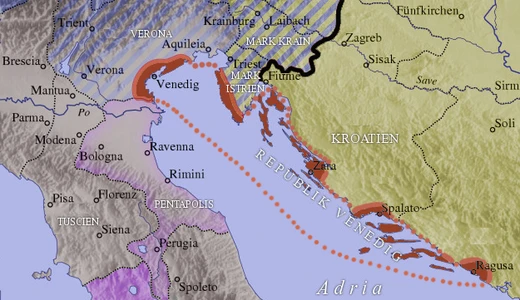
Under the Republic of Venice, Este experienced economic growth, interrupted only by the plague of 1630. After the Republic's fall in 1797 and the Napoleonic Wars, Este, with the Veneto region, became part of the Austrian Empire until annexed by the Kingdom of Italy in 1866 following the Third Independence War.
Reader's Guide
Este's significance lies in its dual role as a proto-historic cultural center and the birthplace of a major medieval dynasty. The Este culture, named after the town, represents a key phase in the Italian Bronze and Iron Ages, with the Veneti leaving a rich epigraphic record. As the Roman colony Ateste, it was integrated into the empire and received veteran settlements under Augustus. The town's later history is dominated by the House of Este, which rose from local lords to rulers of Ferrara and other territories, though Este itself was lost as a capital in 1240. Its medieval and Renaissance legacy is visible in landmarks such as the Duomo of Santa Tecla, the Castello Carrarese, and the Museo Nazionale Atestino. Under Venetian rule, Este prospered economically until the plague of 1630. Its modern identity as a center for farming, crafts, and industry continues this long history of regional importance. The town's layered past—from proto-historic Veneti to Roman colony, medieval lordship, and Venetian subject—makes it a microcosm of northern Italian history.
Did You Know?
- Este lends its name to the Este culture, a proto-historic culture of the late Italian Bronze Age to the Roman period.
- During the Iron Age, Este was a major center of the Veneti, who left inscriptions on funerary and votive objects.
- After the Battle of Actium, Emperor Augustus settled soldiers of Legio V Alaudae and Legio XI Claudia in Este's territory.
- The House of Este took its name from the castle built there by Azzo II d'Este after the 10th century.
Frequently Asked Questions
What is Este, Veneto?
Este is a small town and comune in the Province of Padua, nestled at the foot of the Euganean Hills in northern Italy. It is best known as the geographic birthplace of the medieval House of Este, a dynasty that derived its very name from the settlement.
What is the Este culture and where does it come from?
The Este culture is a proto-historic cultural complex that spans from the late Italian Bronze Age through the Roman era. It takes its name from the town of Este, which is regarded as the central area of that archaeological tradition.
When was the Roman colony at Este founded?
The Roman colony was established in the late second century BC, roughly around 135 BC. This placed it among the earlier Roman footholds in the Veneto hinterland.
Why is Este, Veneto considered historically significant?
The town serves as the namesake for both the proto-historic Este culture and the powerful medieval House of Este, one of the most influential ruling dynasties in northern Italy. Its position at the base of the Euganean Hills gave it lasting symbolic and strategic weight in regional affairs.
How does Este fit into the broader Veneto landscape?
Located within the Province of Padua, Este sits in the heart of the Veneto region that was long shaped by competing Italian powers. Its identity as the origin point of the Este dynasty made it a recurring focal point of local politics, culture, and territorial claims throughout the medieval period.
More in Territories of the Republic of Venice 1-24
Spotted an error? Know more?
This is a living reference — every entry is fact-audited, and reader corrections feed straight into our audit queue. Suggest an edit · See this site's audit record