Frequently Asked Questions
The most-asked questions about territories of the republic of venice.
What exactly is the Republic of Venice and what did its territories include?
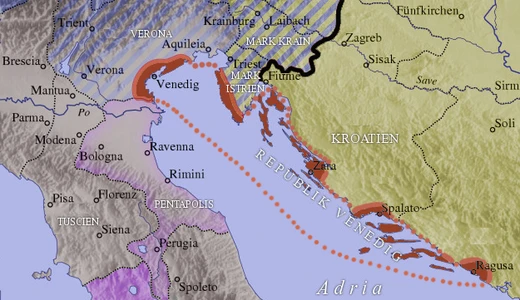
The Republic of Venice, or Serenissima, was a maritime state that existed from the late 7th century until 1797. Its territories spanned the Venetian Lagoon, a vast mainland domain called the Terraferma, the Dalmatian coast, the Ionian islands, and at various points Crete, Cyprus, and parts of the Peloponnese.
Who were the most important figures in Venetian governance?
The Doge was the elected head of state, chosen through a complex multi-stage process designed to prevent any single family from dominating. Below the Doge, the Council of Ten, the Great Council, and numerous specialized magistracies shared real power, making Venice one of the most layered political systems of its era.
What was the Terraferma and why did it matter?
The Terraferma was the mainland territory Venice acquired from the 14th century onward, stretching across the Veneto, Friuli, and parts of the Po Valley. It transformed Venice from a purely maritime power into a major continental state and became the agricultural and economic backbone of the republic.
How did Venice come to control territories in the eastern Mediterranean?
After the Fourth Crusade in 1204, Venice received a large share of the conquered Byzantine lands, including Crete, parts of the Peloponnese, and various islands. This maritime empire gave Venice critical trade routes and naval bases that sustained its commercial dominance for centuries.
When and how did the Republic of Venice fall?
Napoleon's armies occupied Venice in May 1797, and the Great Council formally dissolved the Doge's authority on May 12 of that year. The territory was then ceded to Austria under the Treaty of Campo Formio, ending over a millennium of Venetian self-governance.
What was the Council of Ten and why is it so famous?
The Council of Ten was a secretive governing body created in 1310 to safeguard the state against internal and external threats. It oversaw espionage, censored publications, and could try citizens without the usual legal protections, making it one of the most feared institutions in pre-modern Europe.
Where should a newcomer start if they want to understand Venetian territories?
A good entry point is studying the four main geographic zones: the Lagoon itself, the Terraferma, the Dalmatian and Ionian holdings, and the former eastern Mediterranean possessions. Tracing how each region was acquired, governed, and eventually lost gives a clear narrative arc.
How was Venice's political system different from other Italian states?
Unlike the hereditary principalities of the peninsula, Venice used an elaborate electoral college to select its Doge and distributed power among dozens of councils and magistracies. This system was explicitly designed to prevent oligarchic capture and kept the same constitutional framework in place for roughly six hundred years.
What happened to Venice's overseas holdings after the 15th century?
The loss of Crete to the Ottomans in 1669 and the gradual erosion of Ionian holdings marked the end of Venice's eastern Mediterranean empire. By the 18th century, the republic's reach was essentially limited to the lagoon, the mainland, and a shrinking Dalmatian coastline.
Why do fans and historians find the Republic of Venice so compelling?
Venice combined a unique geography—built on islands in a lagoon—with an extraordinarily long-lived constitutional republic and a global trading network. The tension between its maritime identity and continental ambitions, capped by the dramatic 1797 collapse, makes it a rich subject for study and storytelling.